Use case
Hazard visibility
Communicate the risk before behaviour has to change.
Use warning signs where the core job is to make a hazard recognisable before a person moves deeper into the situation.
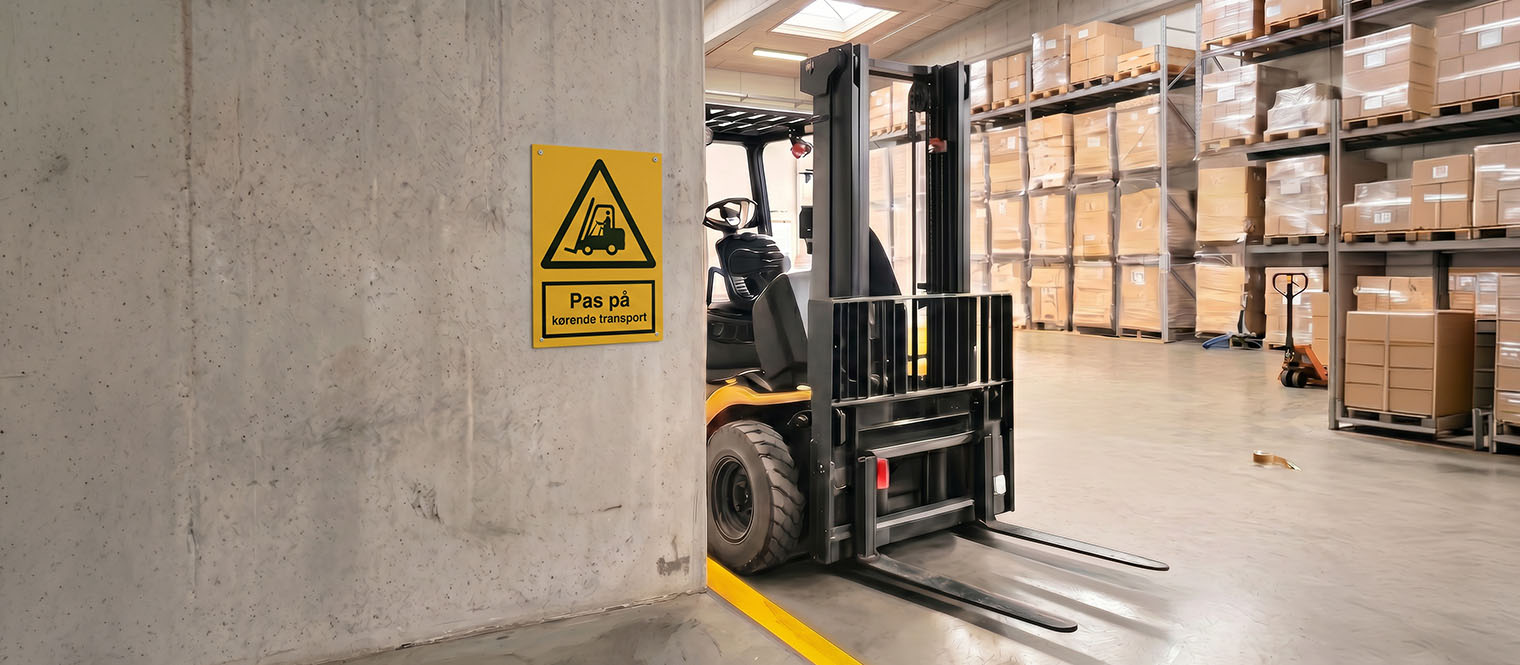
Warning signs belong where a hazard must be recognised quickly enough to change behaviour. Start with the operational role, then select signs and materials for the actual site conditions.
Which symbol applies follows from the hazard. What the sign is made of follows from the site: the surface it mounts to, the cleaning it will meet, whether it is read in daylight, in low light or after a power failure. Those are two separate questions and it is worth answering them separately.
Standards
Warning signs are the yellow triangles: ISO 3864-1 fixes the shape, the safety yellow and the black border, and ISO 7010 registers the symbols inside them under W-codes. The sign has to be read before the hazard is reached, so viewing distance sets the size and the location decides the material.
The registered safety signs. Symbols are reproduced as registered, not redrawn.
Safety colours, geometric shapes, and the relationship between viewing distance and sign size.
The design rules a graphical symbol is drawn by, including one that is not in the register.
Classification, performance and durability: material class, environment, service life and the test behind it.
Use where the goal is to stop a specific action rather than flag a hazard.
View categoryDescribe the hazard, the viewing context, and whether the sign is part of a wider safety-sign package.