IMO A.1116(30)
Escape route signs and equipment location markings
Marine escape signs show the way from occupied spaces through corridors, stairs and exits. They give direction where a route branches, identify the exit itself, and mark destinations such as assembly or muster stations.
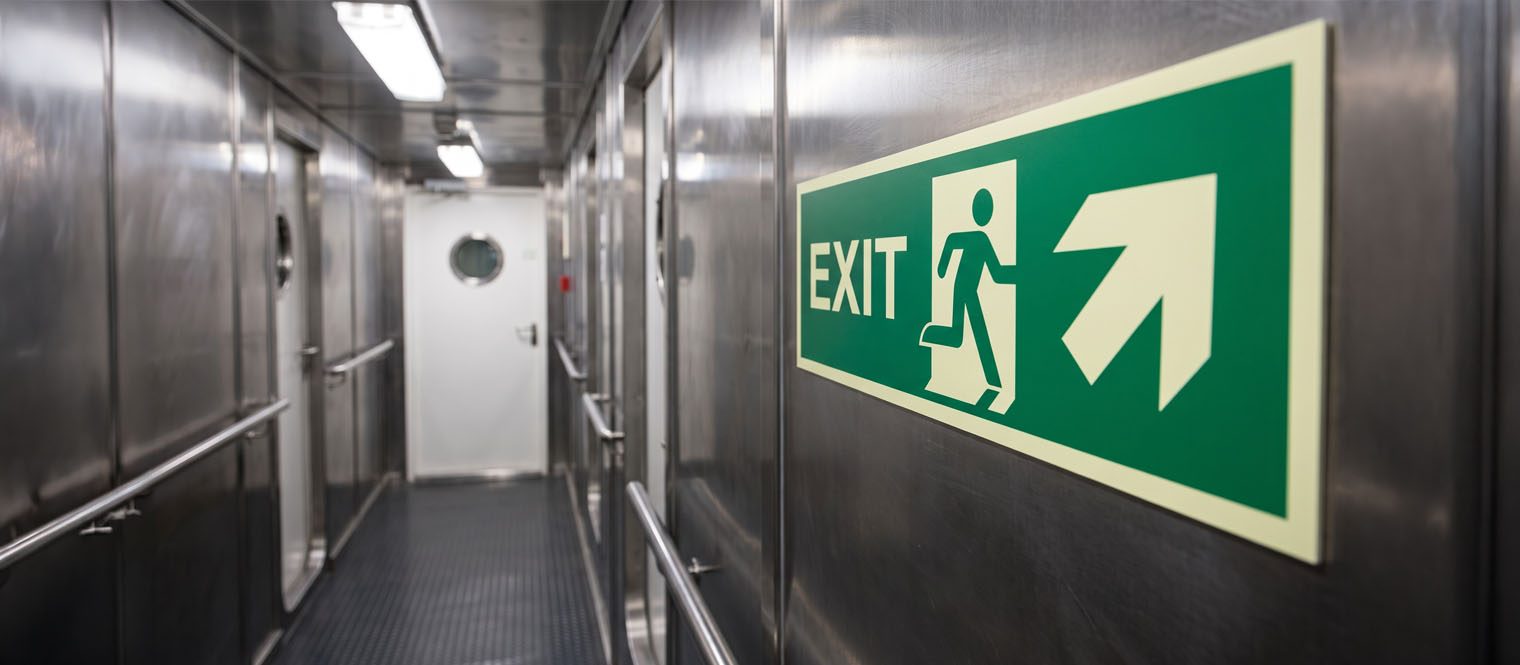
The next instruction needs to be visible before a person has to choose a direction.
A route may pass through several decks and enclosed spaces before reaching its destination. Arrows at corridor junctions and stair landings connect those sections.
The approach determines how an arrow is understood. A sign that reads clearly from one corridor may be ambiguous from another, particularly where stairs and doors sit close together. Each sign needs to describe the next movement from the position of the person reading it.
An exit sign identifies the opening used to continue along the route. Door-opening instructions provide a different piece of information: how that opening is operated.
Sliding doors, push or pull arrangements and escape hatches can require distinct messages. The instruction belongs beside the relevant mechanism or opening, with wording and symbols that correspond to its operation.
Muster and assembly station identification connects the route with the destination used in onboard instructions. Deck and stairwell references give additional orientation along the way.
Low location marking can follow the same path near deck level, while life-saving signs identify equipment at or beyond the destination. These elements need consistent directions and names so the journey described during familiarisation matches the route seen aboard the vessel.
Standards
IMO Resolution A.1116(30) sets out escape route signs and equipment location markings. It applies to ships built from 1 January 2019, and to ships under repair, alteration or outfitting from that date, under SOLAS chapters II-2 and III. ISO 24409-1 covers how shipboard signs are designed; ISO 24409-3 covers where they belong and how they are used together.
Escape route signs and equipment location markings
Design principles for shipboard safety signs, fire control plan signs, safety notices and safety markings
Code of practice: where signs belong on board and how they are used together
Escape route direction signs for corridors and stairways, exit identification, door-opening instructions including sliding-door operation, and assembly and muster station identification.
IMO Res. A.1116(30), Escape route signs and equipment location markings, adopted in 2017, is the governing resolution and applies under SOLAS chapters II-2 and III. ISO 24409-1 covers how the sign is designed and ISO 24409-3 covers where it belongs.
From the position of the person reading them. A sign that reads clearly from one corridor can be ambiguous from another, particularly where stairs and doors sit close together. Each sign has to describe the next movement, and the next instruction needs to be visible before a direction has to be chosen.
Low location light follows the same path near deck level, and life-saving signs identify equipment at or beyond the destination. All of them need consistent directions and names, so the journey described during familiarisation matches the one seen on board.
No. DENFOIL is supplied through distributors, who quote the specification and handle the order.
Tell us the vessel area, where the route runs and whether it connects to low location marking or life-saving equipment. A distributor quotes the specification.