IMO A.1116(30)
Escape route signs and equipment location markings
Low location marking follows an escape route close to deck level, tracing the path through accommodation corridors, enclosed passages, stairways and door openings.
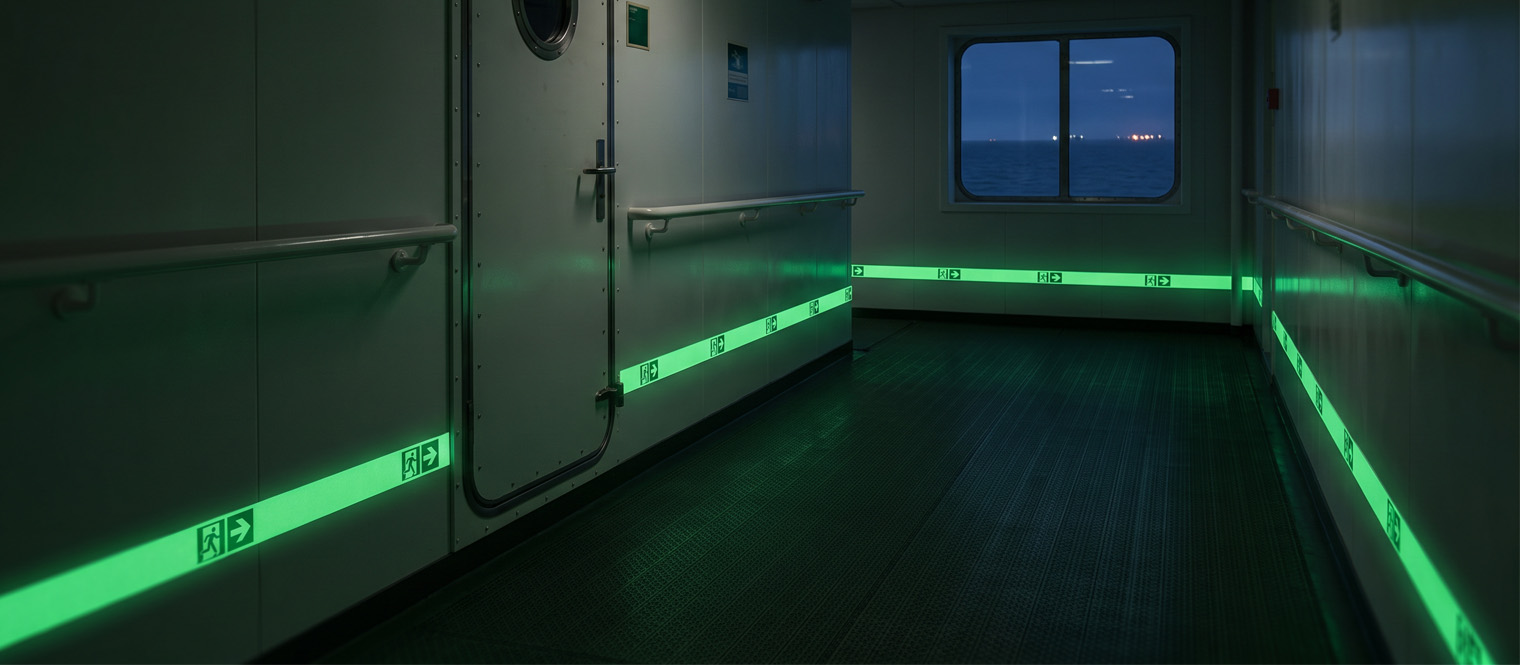
Its purpose is to make the course of the route recognisable along the lower part of the space.
A straight corridor is only one part of an escape route. Doorways, corners and landings interrupt the line and introduce a new choice of direction.
Marking at these transitions shows where the route continues. The connection between sections matters: a clearly marked passage still leaves a question if the direction beyond its next doorway is unclear.
Along a bulkhead, the marking follows the available lower surface. At a stairway, it relates to the change between levels. At a door, it connects the approach with the opening used to continue.
The arrangement may involve route strips, directional elements and the fittings that hold them in position. Existing profiles, corners and surface changes are relevant when replacing a section or extending a route during refurbishment.
Low location marking accompanies the escape signs used elsewhere in the passage. Both need to point along the same route, with exit identification confirming the relevant opening.
The route layout determines the components needed. Material and performance requirements belong to the individual installation and product specification, so a replacement needs to be considered as part of the existing arrangement, including its mounting details and lighting conditions.
Standards
IMO Resolution A.1116(30) sets out escape route signs and equipment location markings. It applies to ships built from 1 January 2019, and to ships under repair, alteration or outfitting from that date, under SOLAS chapters II-2 and III. ISO 24409-1 covers how shipboard signs are designed.
Escape route signs and equipment location markings
Design principles for shipboard safety signs, fire control plan signs, safety notices and safety markings
Clear vinyl elements for the lower part of an escape route: escape route markers and directional arrows, emergency exit left and right, emergency stairs left and right, and assembly station markers, in 50 × 50 mm and 50 × 100 mm, with longer formats where the wording needs them.
Along the available lower surface of the bulkhead, and — more importantly — at the transitions. Doorways, corners and landings are where the line is interrupted and a new choice of direction appears. A clearly marked passage still leaves a question if the direction beyond its next doorway is unclear.
They have to point along the same route. Low location marking follows the path near deck level while the means of escape signs identify the route and the openings at normal height. Exit identification confirms which opening the route continues through.
A replacement is best considered as part of the existing arrangement rather than on its own: the mounting details, the surfaces and any fitted profiles decide what will work. Material and performance requirements belong to the individual installation and its product specification.
No. DENFOIL is supplied through distributors, who quote the specification and handle the order.
Tell us how the route runs, where it turns or changes level, and what the existing arrangement looks like. A distributor quotes the specification.