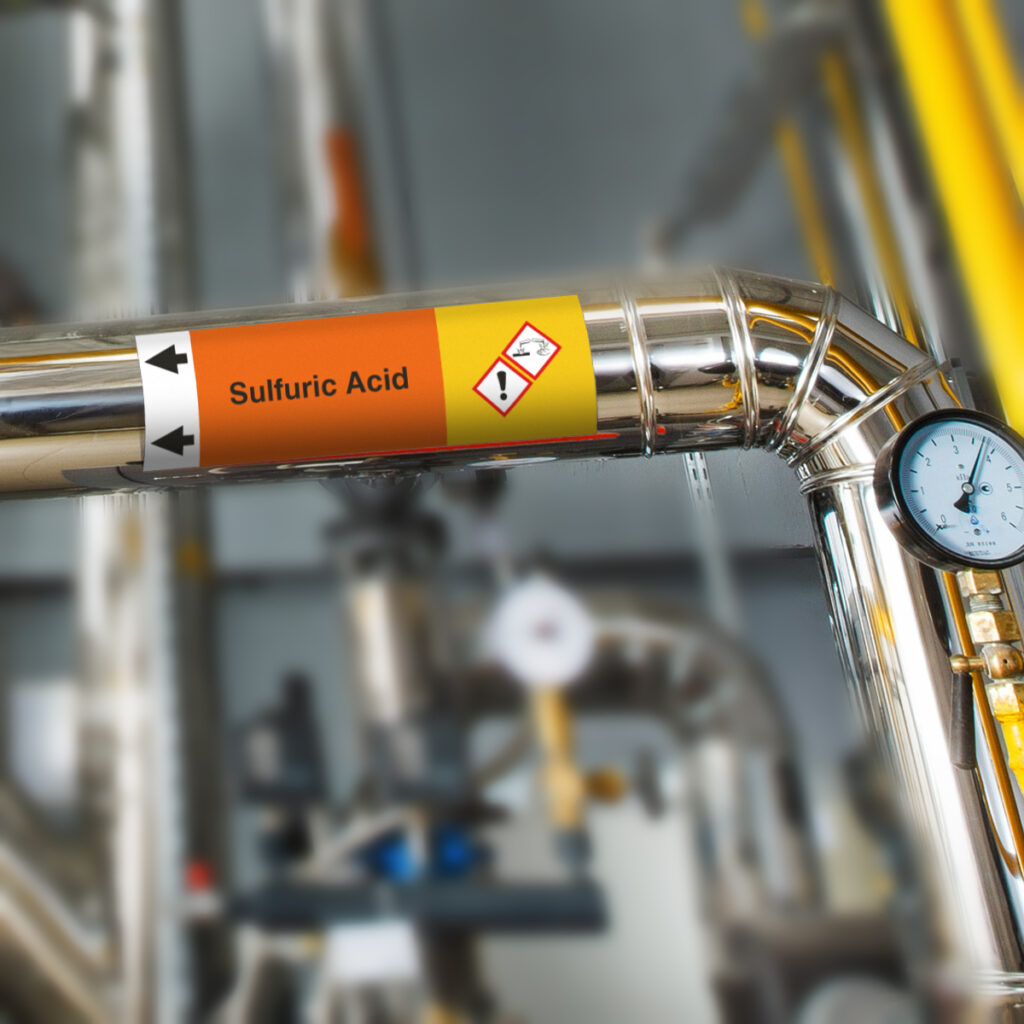
Ask three facility managers what the colour on a pipe marker means and you may get three answers. Older national colour-code systems relied on staff memorising a colour-to-content table, and those tables differed between countries and industries. ISO 20560-1:2024 takes a different approach: the marker itself states what is in the pipe, how hazardous it is, and which way it flows. Colour still carries meaning — but it supports the information on the label; it does not replace it.
This article explains how content identification works under ISO 20560-1:2024, where colour coding still applies, and what to check before you specify pipe marking for an industrial site or a vessel.
What ISO 20560-1:2024 actually fixes
ISO 20560-1:2024 (second edition, June 2024) covers safety information for the content of piping systems. Its companion standard, ISO 20560-2:2023, covers tanks and vessels. Together they define a marking layout built on three elements:
| Element | What it does | Governing reference |
|---|---|---|
| Content name | States what the pipe carries, in text | ISO 20560-1:2024 |
| Hazard pictogram(s) | Signals the hazard class of the content | GHS / CLP |
| Flow direction | Shows which way the medium moves | ISO 20560-1:2024 |
Two consequences follow from this design:
The label is readable without training. A contractor, an auditor or an emergency responder does not need to know a site-specific colour table. The content name is written out, and the hazard pictograms are the same GHS/CLP symbols used on chemical packaging and safety data sheets.
The hazard signal follows the substance classification. The pictograms on the marker come from the GHS/CLP classification of the medium in the pipe. That classification already exists in your safety data sheets, so the marking inventory can be derived from documentation you hold today.
Sizing: the pipe decides the label
ISO 20560-1:2024 sizes the marker to the outside diameter of the pipe run. A marker that is legible on a 200 mm process line is not automatically legible on a 25 mm feed line, so label height scales with pipe OD. In practice this means a marking survey starts with a diameter list, not a label catalogue: record the OD of each run, then select marker sizes from the sizing rule.
DENFOIL® pipe content markers (PMDS series) are produced to the ISO 20560-1:2024 layout and sized by pipe OD, as pre-printed text markers. The size-by-diameter table for each format is stated in the product documentation — request it before ordering rather than estimating from a photograph.
Where colour still carries meaning
Colour has not disappeared from pipe marking. It appears in three distinct roles, and keeping them apart avoids most specification mistakes.
1. Safety colours under ISO 3864-1:2011
ISO 3864-1:2011 fixes the design principles for safety colours and safety signs. The four safety colours keep the same general meaning across all safety marking:
| Safety colour | General meaning |
|---|---|
| Red | Prohibition; fire-fighting equipment; danger |
| Yellow | Warning; caution |
| Blue | Mandatory action |
| Green | Safe condition; escape and first aid |
On a pipe marker, colour used this way reinforces the hazard message that the text and pictograms already carry. Safety meaning must never depend on colour alone — colour vision deficiency and poor lighting are normal working conditions, which is exactly why ISO 20560-1:2024 puts the content name and pictograms at the centre of the label.
2. Identification banding
Sites often band long pipe runs at intervals so a run can be followed visually across racks and through wall penetrations. DENFOIL colour marking rolls (PMRL5–PMRL75 series) are supplied in 13 colours on 100 m rolls for this purpose. Banding is an identification aid on top of the ISO 20560-1:2024 content markers — it does not replace them, because a colour band alone states neither the content nor the hazard.
3. The maritime colour system: ISO 14726
Ships and offshore installations use a separate, fixed colour system: ISO 14726 assigns colours to media groups in shipboard piping. DENFOIL maritime pipe-marking bands (130019–130030 series) cover the 12 ISO 14726 colours and are supplied as 50 mm × 30 m rolls. If you specify marking for a vessel, ISO 14726 is the colour reference — do not carry an onshore banding scheme onto a ship, and do not assume the two systems agree. Maritime marking is English-language by default.
| Colour | Item number | Format |
|---|---|---|
| Maroon | 130019 | 50 mm x 30 m |
| Yellow ochre | 130020 | 50 mm x 30 m |
| Violet | 130021 | 50 mm x 30 m |
| Brown | 130022 | 50 mm x 30 m |
| Red | 130023 | 50 mm x 30 m |
| Grey | 130024 | 50 mm x 30 m |
| Black | 130025 | 50 mm x 30 m |
| Blue | 130026 | 50 mm x 30 m |
| Orange | 130027 | 50 mm x 30 m |
| Green | 130028 | 50 mm x 30 m |
| Silver | 130029 | 50 mm x 30 m |
| White | 130030 | 50 mm x 30 m |
The twelve identification colours DENFOIL supplies as maritime pipe-marking bands. Swatches are screen approximations for identification while reading, not a production colour reference. Which media group each colour identifies is defined in ISO 14726:2008 and stated in the product documentation.
Choosing the right combination
For a typical industrial or marine marking project, the components map like this:
| Task | Product type | Format | Reference |
|---|---|---|---|
| Identify content and hazard | Pipe content markers (PMDS series) | Sized by pipe OD, pre-printed text | ISO 20560-1:2024, GHS / CLP |
| Follow a run visually | Colour marking rolls (PMRL5–PMRL75) | 13 colours, 100 m rolls | Site identification scheme |
| Show flow direction | Flow-direction arrows (130047) | Wrap band | ISO 20560-1:2024 |
| Mark shipboard media groups | Maritime pipe-marking bands (130019–130030) | 12 colours, 50 mm × 30 m | ISO 14726 |
| Mark tanks and vessels | Tank identification | Per documentation | ISO 20560-2:2023 |
Materials: the environment decides
A pipe marker is only compliant for as long as it is legible. Process areas expose marking to cleaning agents, oils, UV and temperature swings, so the substrate matters as much as the layout. DENFOIL pipe marking is produced in chemically resistant self-adhesive film, resistant to UV, oils and common process chemicals, and is supplied as wrap-around sleeves or self-adhesive labels depending on the run.
Before ordering, check the product documentation for the specific film's resistance data against the media and cleaning regime in your plant. A marker that fades or lifts is a finding at your next audit.

A practical survey sequence
1. List the runs. Record content, GHS/CLP classification (from the safety data sheet), pipe OD, and indoor/outdoor exposure for each run. 2. Derive the markers. Content name and pictograms follow from the classification; marker size follows from the OD. 3. Add direction and banding. Place flow arrows where staff actually approach the pipe; add colour banding where runs need to be followed across distance. 4. Separate marine from onshore. Vessels follow ISO 14726 colours and English-language marking; onshore sites follow ISO 20560-1:2024 with your site's banding scheme documented. 5. File the documentation. Keep the marking survey and the product datasheets together — the survey is your evidence that the marking matches the media.
Documentation before ordering
Every DENFOIL product line states which standards it is designed to meet, and the claims are anchored in the product documentation rather than in this article. Request a document package for pipe marking, or find your distributor in Denmark, Norway, Sweden or the Netherlands to review a marking survey for your site.