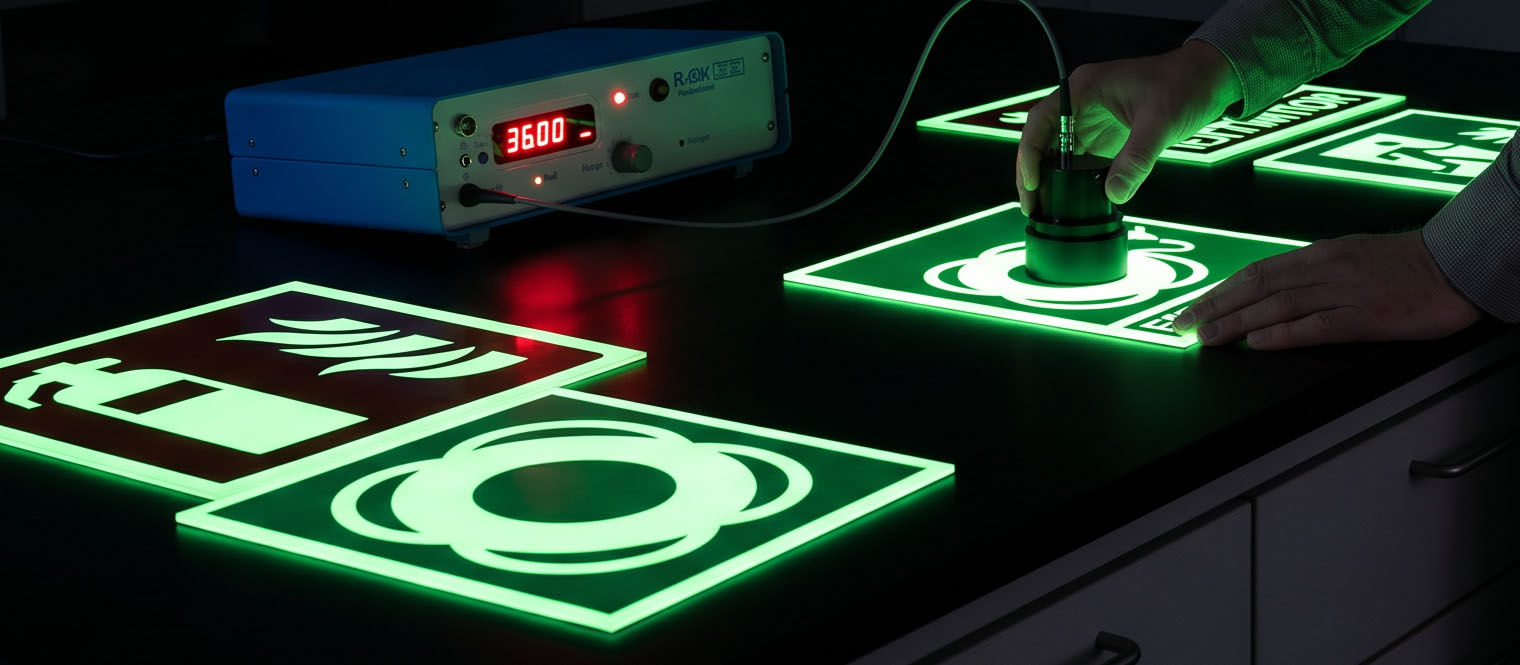
A photoluminescent material stores light and gives it back. While the lights are on, the pigment absorbs energy; when they go off, it releases that energy as visible light over the following minutes and hours. Nothing is burning, nothing is powered, and nothing is radioactive. What follows from that is a specification problem: performance is a curve rather than a state, and a figure taken from that curve means nothing without the conditions that produced it.
It has to be charged, and it fades
Two consequences follow from how the material works, and both matter when specifying.
- It has to be charged. A sign in a cupboard, behind a door, or in a space that is normally unlit will not perform, however good the material. The light that reaches the sign in normal use is part of the specification, not a detail.
- It fades. The material is brightest in the first seconds after the lights fail and dimmer an hour later. Any honest figure therefore names a moment on that curve.
Why a single number means nothing
“High luminance” is not a specification. A luminance value is only meaningful together with the conditions that produced it, and there are three.
- The light source. A daylight-simulating source and a warm office fluorescent excite the pigment differently.
- The illuminance. A material charged at 1000 lx and the same material charged at 25 lx produce very different curves. The two cannot be compared, and should never appear in the same table without their conditions.
- The charging time. Longer charging gives higher values. A figure measured after fifteen minutes is not the same claim as one measured after five.
This is why a datasheet states luminance in mcd/m² at named intervals after a defined excitation, rather than as a headline number.
How the measurement is done
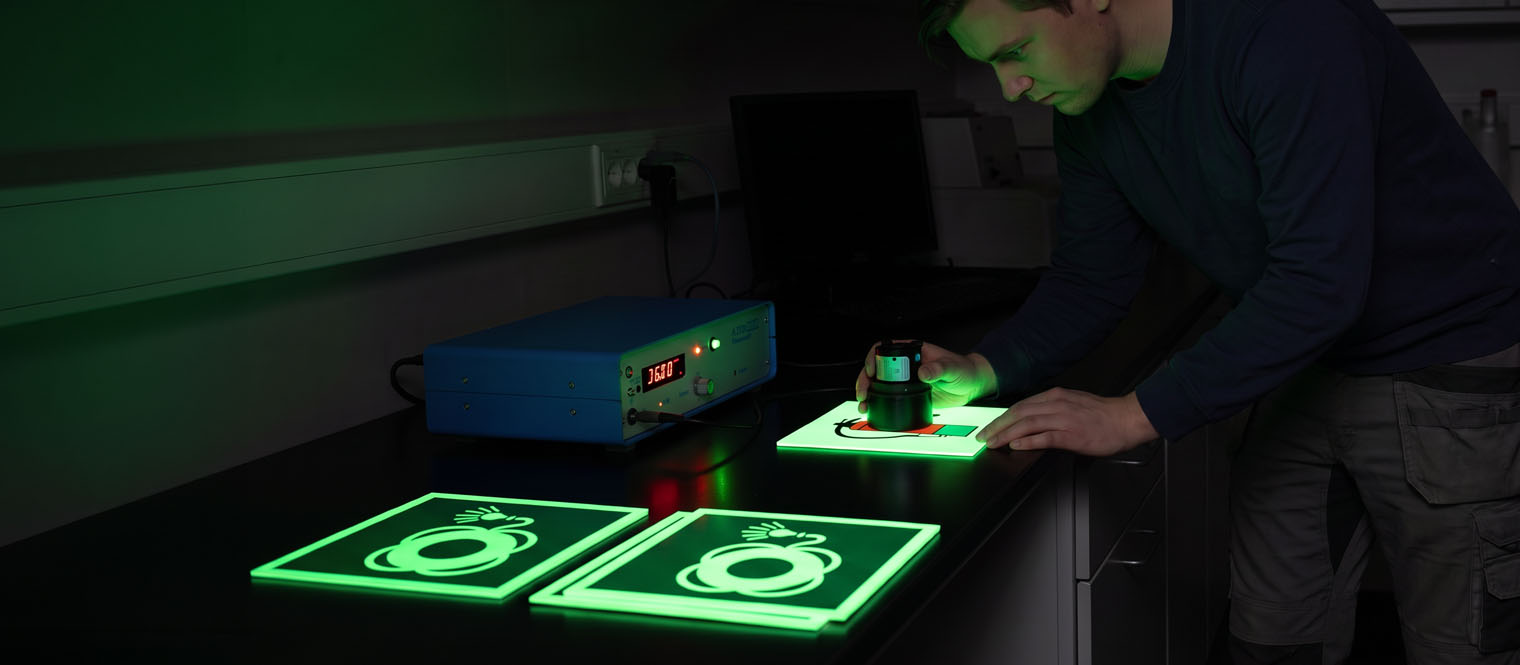
The measurement produces a decay curve under controlled conditions. The sample is first kept in darkness for a defined period, so that no residual charge distorts the result. It is then charged with a named light source at a named illuminance for a named time. Luminance at the material’s surface is recorded at intervals as it decays.
From that curve come the figures a specifier uses: luminance at 10 minutes and at 60 minutes, and the time taken to fall to 0.3 mcd/m², the conventional end point for the measurement. A laboratory photometer such as the LMT B 520 L is the type of instrument used, measuring a defined field on the sample surface and logging the decay automatically.
What this measurement is not. It records luminance at the material’s surface, in mcd/m². It does not record illuminance in lux at a distance from the sign. A few markets — Belgium and the Netherlands among them — set requirements for lux at floor level instead, which is a different quantity and needs a different measurement. Establish which one a specification means before answering it.
What the class notation means
Photoluminescent materials are grouped into performance classes written as two numbers, such as 150-20 or 315-40. The numbers are the minimum luminance in mcd/m² at 10 minutes and at 60 minutes after the defined excitation ends.
The notation is a shorthand for two points on the decay curve. It is useful, but it compresses a great deal: two materials in the same class can behave differently in the first minute or after four hours, which is where the curve itself tells you more than the class does.
Which standard answers which question
| Question | Standard |
|---|---|
| How is the material measured and classified? | DIN 67510 — part 1 is the measurement method, part 4 the classification |
| How are a sign material’s photometric and colorimetric properties defined so they can be measured? | ISO 3864-4 |
| How is a sign classified for material, environment and expected life? | ISO 17398 |
| How do signs and markings combine into an escape route that can be followed without power? | ISO 16069 |
| How is an escape and evacuation plan drawn? | ISO 23601 |
| What does electrical emergency lighting have to deliver? | ISO 30061 / CIE S 020 |
| Which symbol is used, in which colour and shape? | ISO 7010, with ISO 3864-1 |
The distinction that catches people out: ISO 16069 is assessed for the installed system — where the markings sit, whether the guidance line stays continuous, and how doors, stairs and changes of direction are marked. It is not assessed for a single product. A photoluminescent sign is a component of a way guidance system; it is not a way guidance system on its own.
Where the requirement comes from at sea
Under SOLAS chapters II-2 and III, escape routes and the locations of safety equipment have to be marked so they can be found in darkness and in smoke.
IMO Resolution A.1116(30), adopted in 2017, sets out the escape route signs and equipment location markings. It applies to ships built from 1 January 2019, and to ships under repair, alteration or outfitting from that date. Older ships are not automatically brought into scope, so the build date is the first question to settle.
Low-location lighting on passenger ships — the marking near deck level that keeps the route followable when smoke obscures everything higher — has its own standard, ISO 15370.
Where the requirement comes from on land
There is no single European standard that a photoluminescent product is approved against. Workplace safety signage sits under Directive 92/58/EEC, which is a minimum directive: it sets out what member states must require, and national building and fire regulations decide the rest. Requirements therefore differ by country and by building type, and the escape route design is usually settled by the fire strategy for the building rather than by a product standard.
What ISO 16069 provides is the system: mounting heights, continuity of the guidance line, and the marking of doors, stairs and direction changes, for photoluminescent and electrical systems alike.
Photoluminescent marking does not replace emergency lighting. Whether a building needs electrical emergency lighting, photoluminescent guidance, or both is a design decision for whoever is responsible for the fire strategy. It is not a product substitution.
What to ask a supplier for
For each figure: the value, the unit, the excitation conditions, the measurement standard, and the point on the decay curve it refers to. A figure without its conditions cannot be compared with a competitor’s, and cannot be defended in a tender.